Artopol Gallery: Why Artopol?
UMUT SUNGUR: The richness and diversity of Artopol's collection was an important factor for me. The inclusion of figurative works was also meaningful and impactful since my own works are mainly figure-based. When I saw that there was no rigid attitude in the art market, that Artopol had a flexible team open to differences and innovation, easy to communicate with, and willing to collaborate on projects, I realized I could work with them. I believe there is so much that can be done for art, and I trust that with Artopol we can make these things happen. I think together we can reach more people, share the emotions and thoughts we want to convey through art, and create awareness.
AG: Accessibility is already one of the main focuses of Artopol. In this sense, we place great importance on online activities. How do you view these initiatives?
US: I think being present on online platforms is extremely important, especially nowadays. For example, I can follow the works of an artist from North America. In the past, we could only learn about art from books or magazines, so it was hard to access fresh information. But now, art reaches more people than ever; we can share in the dreams of someone we’ve never met. Online sales are also beautiful in their own way — they allow us to own works by artists from far away. So why should we limit ourselves?
I value the support of virtual platforms for accessibility, and I think there’s another layer to it: learning by watching and observing is very important. Through the internet, we can access online courses and learn a lot from videos that artists upload. For example, I have a small sculpture project — a little horse head. At home, I also make things with my children using clay, but I haven’t yet solved the mathematics of sculpture. It’s something I want to learn, and I’m trying to benefit from videos on this subject.
During the pandemic, I used the internet even more. I did a lot of research, discovered many artworks, artists, photographs, and sculptures, and was inspired by many of them.
AG: So you’re one of those who turned the pandemic into an opportunity.
US: Yes, I am. I produced much more. I was always at home, of course. There were distractions, things that kept me busy, but the chaos that comes with being outside was reduced. I could concentrate more easily — especially in the hours after the day’s chores were done. The time we used to spend going from place to place was now ours.
AG: How did you start with art?
US: I used to play the piano as a child. I loved listening to music and singing. But painting wasn’t something I practiced. My mother used to paint in oils at home. I would watch her and comment in my own way. My father had a vinyl collection, and on weekends we’d listen to his records together. So art was always a part of our home and life. My real encounter with painting came after leaving a 15-year corporate career and when my children reached school age. I found myself in a period of searching. I wanted to create, to learn, to make something, to leave something behind. I wanted to do something that allowed me to express myself, made me feel good, excited me, and that I could share with others. In this process of self-discovery, I decided to engage in art. I wanted to use my hands. I wanted to learn sculpture. I started with drawing, learned to use oil paints, and joined various workshops. I also studied abroad, in London. I’m still a student — sometimes learning online, sometimes face to face — constantly improving myself. I’m currently studying art history as well and will soon start sculpture lessons.
AG: Let’s talk about your works. They are all figurative and clearly tell stories. Is there an overarching theme, or do they each tell different stories?
US: All my works are parts of a story, interconnected. I focus on emotions and portray them through women. Of course, emotions are not exclusive to women — everyone experiences them. But I wanted to tell them through the female perspective. I was inspired by the realities of violence and oppression faced by women. I wanted to show how societal norms, family, workplace, friendships, and traditions — the things we are taught and sometimes experience willingly or unwillingly — reflect in women. Women experience sadness, joy, and pain alike. Like being in an unwanted marriage… She feels anger but may not express it outwardly — she lives that storm inside herself. Because society has expectations of women, assigns them roles, and sometimes says, “Be quiet!” She has things she wants to say but doesn’t — or can’t. Maybe she’s told, “Don’t see this, don’t hear that!” But she is an individual, here to experience life fully. To make that possible, our minds must be open and our thoughts flexible and free. The butterflies, for example, symbolize that.
So I combine psychology and emotions in my work. I try to reflect and convey human feelings in my own way.
AG: Was this desire to raise awareness something you had from the start, or did it develop gradually?
US: It developed gradually. I’ve always been interested in the figure. I started painting with flowers — my first painting was of daisies, actually. But my hand and soul always drifted toward portraits. As I improved technically and gained confidence, I began to paint portraits. If I painted a flower, I’d paint a figure right after.
This theme was encouraged by things we experience and encounter daily. My first solo exhibition also had a female theme. There, I combined 18th and 19th-century female figures with modern objects to critique capitalism. The object I chose was Coca-Cola cans.
In my recent works, using the language of art, through my paintings and as a woman, I wanted to draw attention to the issues women face around the world. I wanted to reflect their thoughts, feelings, and experiences. I aimed to provoke thought, build empathy, communicate, shape values, and create connections between us. I believed that my paintings could help viewers better understand others’ emotions. If we don’t try to understand, if we don’t empathize, if we stay silent, just observe, and fail to act — aren’t we then siding with what’s wrong?

AG: The distinctive side of your work is that you make your figures unique not by deforming them but by playing with material. Your figures maintain their classical form, but your theme modernizes them. Material clearly has a special place in your art. How did this interaction begin?
US: I love dimensionality. I actually started art wanting to sculpt but couldn’t find the right education. I didn’t know where to go. I wasn’t happy with the places I tried. People in my circle who were from the art world told me that the foundation of sculpture is drawing. So I started drawing to prepare for sculpture. But when I got to oil painting, I got stuck — because I fell in love with colors. I loved expressing myself through color. I always say that art is the best meditation and mindfulness practice. When I paint, I lose track of time. I stop thinking about my problems and only focus on where to place each color. When I finish a painting, my mood changes. Even if I start the day badly, I feel great when I’m done. I want others to experience this too, which is why I try to share it through the workshops I give. I think everyone should engage in some form of art.
I formed a strong bond with oil painting, but sculpture is still on my mind. As I said, I love dimension. You can create depth in a painting through light and shadow, but I wondered, “What else can I do?” I began adding materials, then cutting into the canvas and creating forms from it to achieve depth. I realized that I could achieve a stronger and more beautiful expression this way.
AG: Apart from your main themes, do any of your works have independent stories? Can you share one?
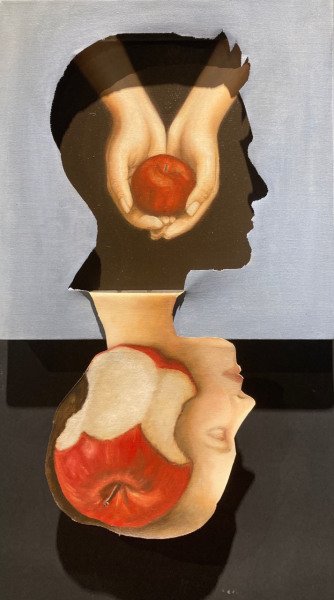
US: I can tell the story of “The Apple.” Life is never complete; we all have flaws, and our expectations differ. In relationships, we seek wholeness — to become “one apple.” But as the relationship progresses, we realize who is the red apple and who is the green one. We start to understand our differences. The differences in our expectations and what we can give shape the nature of the relationship. We are connected and need each other — we share similarities as well as differences. We must learn to accept one another as we are, to live with our differences, and to embrace them. Because no one is half an apple, and we won’t become whole by finding our “other half.” Each of us is a complete apple, and together we exist. Men and women form the wings of society. Only when both develop and are equal can we truly fly.
AG: Where do you draw inspiration for your themes and stories?
US: I’m drawn to the women and facial expressions in Renaissance and Baroque paintings. I actually started by trying to copy those works. But I study a wide range of artists and different art movements. I study sculpture as well as painting. Among young artists, I really admire Özüm Koşar. Her interpretations of femininity and aesthetics deeply impressed me. I look at how artists portray women and what they’re trying to say. Now that I think about it, maybe I started depicting women through these influences. Also, since my husband’s work involves psychology, it’s a frequent topic at home. I believe psychology is part of art, and I try to merge the two. Both art and psychology deal with emotions and thoughts. I draw inspiration from those emotions and try to express them.
AG: Will this relationship remain a part of your art, or is it just your current approach? Do you have future goals or new ideas?
US: I think art and psychology will always be part of my life. I believe I’ll continue working with the theme of women for a while. I have many more ideas to bring to canvas. I want to develop my technique as much as possible and learn about different branches of art. I’m reading books on art history. For example, I’ll soon start working with sculpture, but I don’t know where it will lead me. I’d love to combine sculpture and oil painting somehow, though I can’t yet envision how. I suppose the journey will determine that.
AG: Art is full of subjectivity. As an artist, what you’re influenced by and what you wish to express form one side of that — but there are also viewers. Do your viewers ever interpret your works differently? How does that make you feel?
US: I think that’s closely related to the purpose of art itself. It’s not necessary for them to understand exactly what I mean. The viewer should find something within themselves. I’ve questioned this a lot — how should art be read, how should it be understood? I’ve read a lot on this. Eventually, I realized that if I can reach the artist, I can ask them; if not, I focus on what I feel. Even when you can ask, you might not share the same feeling or thought. Take the color red, for example — you might love it, but I might not. Maybe I’ve had a bad experience with that color in the past. My personal experience might stop me from liking that work. So yes, it’s very subjective.
If a viewer doesn’t catch what I’m trying to express, I don’t worry. Everyone can see and feel something different. Maybe there’s something I can learn from their interpretation. What matters is to evoke emotion in the viewer.
AG: How does your creative process begin?
US: I always start by imagining. I choose a theme, decide what to work on, and think about it constantly. I look at paintings related to it. I also read psychological texts about the concept — because if there’s something deeper behind it, I want to understand it too. I think about how I can express it.
Then I decide what I want to do. Sometimes funny moments happen at home — I suddenly say, “I have an idea! I’m going to make this!” and everyone looks at me in surprise.
Once I decide, I move to the sketching stage. Should she look right or left? How should her hand be positioned? I work through these questions.
AG: Do you ever experience creative block? How do you deal with it?
US: Sometimes I just don’t touch it for a while. Even if I have an idea in mind, I can’t always start immediately. But you have to overcome that uncertainty. Making the first stroke is important. A blank canvas can be intimidating — I wonder if I can really express what’s in my head. But only until I make that first mark. Then the rest follows. I also make changes along the way, of course. What matters is standing in front of the canvas with determination. Art teaches you how to make decisions and live with them — it’s one of life’s most colorful journeys.
AG: You nourish yourself both intellectually and technically, yet you’re very humble. How do you describe yourself and your work?
US: I don’t define myself as an artist. I’m still in the learning phase. There’s so much to learn and experience. I say I’m a traveler of art — an art lover.
AG: Do you have a goal? Do you ever think, “If I achieve this, I’ll be a true artist”?
US: I’m not sure we can ever say, “Alright, I’ve reached where I wanted to be.” Learning never ends. Every day you learn something new, and there’s always something else you can improve on. When you reach one goal, you set another. That’s what keeps us connected to life. I think it’s an endless journey — and thankfully so, because without goals, we stagnate and feel a kind of unexplained emptiness.
AG: How do you define art?
US: Art is a form of expression — something that sometimes makes us think, sometimes stirs our emotions. I see art as life itself: vast and boundless. I think it’s difficult to find the perfect definition of art. So when I think about what art is, I always answer with questions: Is art a necessity? A therapy or meditation? A legacy? A language? A stimulus that activates our minds — or entertainment? Is it a tool that helps us become aware of our emotions and thoughts? As long as humanity exists, art will exist — because art is part of life.
AG: What do you think about today’s art market? Are the right steps being taken, and what do you think those are?
US: I’m a new member of this market — or rather, trying to be one. But I read that it’s leaning too heavily toward the commercial side. I believe what’s important is to support art and artists more. Galleries, collectors, and institutions all have a big role to play. It shouldn’t be purely profit-driven. We must remember that art is what carries us into the future. Emerging artists should be given opportunities. We must lend a helping hand to the younger generation. If we don’t help each other, none of us can move forward. There’s a saying: “A chain is only as strong as its weakest link.” Societies without art become coarse, selfish, unable to appreciate, and full of people lacking empathy, imagination, and grace. That’s why we need to be more flexible, inclusive, and open to differences.
For example, when I brought an idea to Artopol for International Women’s Day on March 8, their positive response made me very happy. I believe we’ll create wonderful things together. We all need to extend a hand and give each other opportunities.
AG: Thank you very much, Umut, for this lovely conversation.
US: Thank you.
Interview by: Zeynep Dikmen